What if treating fibromyalgia did not always mean adding another pill?
What if researchers could influence the nervous system itself? That is the idea behind vagus nerve stimulation (VNS), a form of neuromodulation that has attracted growing interest in chronic pain research. The vagus nerve connects the brain with major organs throughout the body. It plays a role in the autonomic nervous system and helps regulate functions such as heart rate, digestion, and the body’s response to stress. Researchers now want to know whether stimulating this nerve could also influence pain, fatigue, sleep, and other fibromyalgia symptoms. So, is a vagus nerve stimulator for fibromyalgia the next breakthrough?
The research is promising.
But the answer is not quite “yes” yet.
What Is the Vagus Nerve?
The vagus nerve is one of the body’s major communication pathways.
It travels from the brain through the neck and into the chest and abdomen. It carries signals in both directions, allowing the brain and body to communicate continuously. The nerve also interacts with the autonomic nervous system, which helps regulate functions that happen automatically. Researchers have become particularly interested in the vagus nerve because of its connection with pain regulation, stress responses, and inflammation.
People with fibromyalgia may have changes in autonomic nervous system function, including lower heart-rate variability. Researchers are investigating whether stimulating the vagus nerve could help influence these systems.
Fibromyalgia does not behave like a simple muscle injury.
Pain processing, sleep, fatigue, mood, and autonomic regulation can all interact.
That makes the condition difficult to treat with one approach.
Vagus nerve stimulation offers a different idea.
Instead of simply blocking pain, researchers are exploring whether neuromodulation can influence the nervous system networks involved in pain and stress regulation.
A 2025 systematic review identified six clinical studies or study protocols involving VNS and fibromyalgia. The researchers reported encouraging signals involving pain, fatigue, sleep, and autonomic regulation, but they also emphasized small sample sizes and differences between study methods.
That distinction matters.
Promising does not mean proven.
How Does a Vagus Nerve Stimulator for Fibromyalgia Work?
There are different forms of VNS.
Some systems use an implanted device. Others stimulate the vagus nerve through the skin without surgery.
For fibromyalgia research, non-invasive approaches have attracted particular attention.
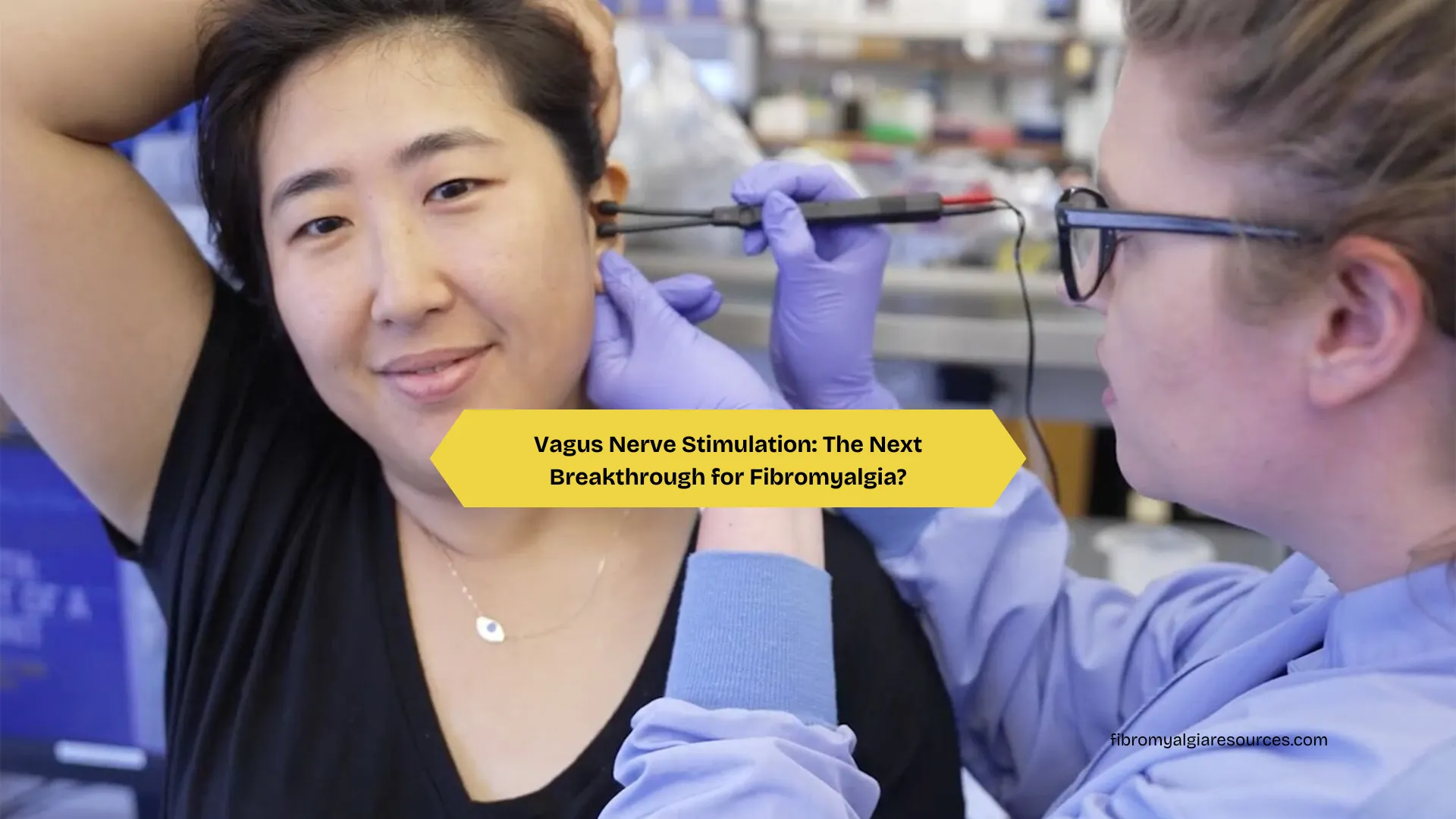
One approach is transcutaneous auricular vagus nerve stimulation, often called taVNS. It uses electrodes placed around parts of the outer ear that have connections with the vagus nerve. Another approach stimulates the cervical vagus nerve through the skin of the neck.
The goal is to deliver controlled electrical stimulation and influence neural activity.
Researchers are still determining which stimulation method, intensity, duration, and treatment schedule work best.
What Does the Research Show So Far?
The evidence has become more interesting in recent years.
A 2026 randomized controlled trial studied 40 women with fibromyalgia who received transcutaneous auricular vagus nerve stimulation. The researchers compared left-sided and bilateral stimulation and assessed pain, mood, function, and autonomic nervous system activity.
Another recent pilot study involved 18 people with fibromyalgia who received auricular vagal neuromodulation five times per week for four weeks. The researchers reported improvements in several measures, including fibromyalgia impact, sleep quality, and widespread pain scores.
These results are encouraging.
But the studies remain relatively small.
A systematic review published in 2025 also concluded that VNS appears promising while noting substantial differences in stimulation methods, outcome measurements, sham controls, and study sizes.
In other words, researchers have a signal.
They still need stronger evidence.
How Could Vagus Nerve Stimulation Affect Pain?
One possible explanation involves the body’s pain-regulation networks.
The vagus nerve communicates with brain regions involved in autonomic regulation and pain processing. Researchers are also studying its relationship with inflammatory pathways.
This has led to a broader idea: perhaps fibromyalgia involves a network problem rather than one isolated source of pain.
A 2025 review described fibromyalgia as involving interactions between perceptual, autonomic, and immune systems. It proposed that VNS could potentially influence several of these systems at once.
That could explain why researchers are looking beyond pain alone.
They are also measuring:
- Sleep
- Fatigue
- Mood
- Heart-rate variability
- Autonomic function
- Overall fibromyalgia severity
Fibromyalgia Vagus Nerve Stimulation and the Nervous System
The phrase fibromyalgia vagus nerve stimulation describes more than an attempt to reduce pain.
Researchers want to understand whether changing autonomic activity can influence the broader symptom pattern. This is important because fibromyalgia symptoms often overlap.
Poor sleep can increase fatigue.
Fatigue can reduce activity.
Reduced activity can affect mood and physical function.
Stress can make pain harder to manage.
If VNS can influence several connected systems, it could potentially become part of a broader treatment strategy.
But researchers still need to establish whether these effects are consistent and clinically meaningful.
Could Deep Breathing Stimulate the Vagus Nerve?
You do not necessarily need an electronic device to explore techniques that influence the body’s relaxation response.
Slow breathing is often discussed in connection with vagal activity.
Deep breathing for vagus nerve stimulation usually means taking slow, controlled breaths with a longer, comfortable exhale.This may help promote relaxation and increase parasympathetic activity. However, breathing exercises should not be described as equivalent to medical VNS devices.
They are different interventions.
Still, slow breathing is generally simple and inexpensive, and some people with chronic pain find relaxation techniques useful.
What About Fibromyalgia Exercises for Vagus Nerve Stimulation?
There is no universally accepted exercise routine that directly “stimulates” the vagus nerve enough to treat fibromyalgia.
However, gentle movement and relaxation exercises may support autonomic regulation and overall well-being.
Possible options include:
- Slow breathing
- Gentle yoga
- Walking
- Tai chi
- Stretching
- Relaxation exercises
The key is pacing.
Someone with fibromyalgia should avoid turning a gentle routine into an intense workout simply because they want faster results.
Gradual activity is generally more appropriate than pushing through a flare.
Is There a Best Vagus Nerve Stimulation Device?
Searching for the best vagus nerve stimulation device can be confusing because different products use different stimulation methods.
Some target the ear.
Others target the neck.
Some devices are designed for specific medical conditions rather than fibromyalgia. That means a device marketed for one condition should not automatically be assumed to work for another.
At this stage, there is no universally established best vagus nerve stimulator for fibromyalgia.
Researchers are still working out which technology and stimulation parameters provide the most reliable results.
What About a Vagus Nerve Stimulation TENS Unit?
Another common search is vagus nerve stimulation TENS unit.
TENS and VNS are not automatically the same thing.
A TENS unit delivers electrical stimulation through the skin to target nerves for pain management. VNS devices are specifically designed to stimulate pathways associated with the vagus nerve.
A generic TENS device should therefore not be assumed to provide medically appropriate vagus nerve stimulation.
If you are considering electrical stimulation, ask a healthcare professional whether the device and its settings are appropriate for you.
Which Vagus Nerve Stimulator Does Bryan Johnson Use?
The question which vagus nerve stimulator does Bryan Johnson use has become popular because of his public interest in health optimization.
But a celebrity’s personal routine should not be treated as clinical evidence.
Even if a specific device is used by a public figure, that does not prove it treats fibromyalgia or that it is appropriate for everyone.
Medical decisions should follow evidence, safety information, and individual circumstances rather than celebrity routines.
Vagus Nerve Stimulation for Cluster Headaches Is a Different Story
Vagus nerve stimulation has also been studied for headache disorders.
For example, non-invasive vagus nerve stimulation has been investigated for cluster headaches and migraine.
That does not mean evidence from headache treatment automatically applies to fibromyalgia.
The conditions involve different mechanisms and treatment goals.
So if you see information about a vagus nerve stimulator for cluster headaches, do not assume the same device or treatment protocol has been established for fibromyalgia.
The research needs to be considered separately.
Could Vagus Nerve Stimulation Help ADHD and Fibromyalgia?
The nervous system is involved in both attention regulation and chronic pain, which makes this an interesting area of discussion.
People living with multiple conditions may also notice overlapping problems with sleep, focus, stress, and sensory sensitivity.
If ADHD is also part of your health picture, you can explore our related guide on fibromyalgia and ADHD.
However, VNS should not be viewed as a proven treatment for both conditions simply because researchers are studying nervous system regulation.
More evidence is needed.
What Are the Risks?
VNS is not risk-free.
Implanted VNS systems involve surgery and can cause device- or procedure-related complications.
Non-invasive stimulation avoids surgery but can still produce side effects such as local discomfort, tingling, skin irritation, headache, dizziness, or changes in voice depending on the stimulation method.
The safety profile also depends on the specific device and where it is used.
Anyone considering a vagus nerve stimulator for fibromyalgia should discuss the option with a qualified healthcare professional rather than experimenting with electrical stimulation independently.
Is Vagus Nerve Stimulation the Next Fibromyalgia Breakthrough?
Maybe.
But it is too early to make that claim.
The research has several encouraging features. Recent studies suggest potential improvements in pain, sleep, fatigue, mood, and autonomic measures. A recent meta-analysis of transcutaneous VNS across chronic musculoskeletal pain conditions also found a potential benefit for pain severity, although the evidence included different conditions and study designs.
At the same time, fibromyalgia-specific research remains limited.
The 2025 systematic review included only six relevant studies or protocols and highlighted methodological differences that make firm conclusions difficult.
That means we need larger, longer, well-controlled clinical trials.
Researchers also need to determine who is most likely to respond.
What Would a True Breakthrough Look Like?
A genuine breakthrough would require more than a few promising studies.
Researchers would need to show that VNS:
- Consistently reduces meaningful symptoms
- Produces benefits that last
- Works better than placebo or sham stimulation
- Has an acceptable safety profile
- Works across diverse patient groups
- Has a clearly defined treatment protocol
Ideally, future research would also identify which patients respond best.
That could move fibromyalgia treatment toward a more personalized model.
What Should Patients Do Right Now?
VNS is an emerging therapy, not a replacement for established fibromyalgia care.
If you are interested in it, start with a conversation with your healthcare provider.
Ask:
- Is VNS appropriate for my symptoms?
- Is there clinical evidence supporting its use?
- Which type of stimulation is being considered?
- What are the potential risks?
- Is the treatment part of a clinical trial?
- How will we measure whether it is helping?
These questions can help separate promising science from marketing hype.
Disability Invisible illess awareness BUMPER STICKER fibromyalgia – stop ther judging you. Click Here to ge this
Bottom Line
Wrapping up, the idea behind a vagus nerve stimulator for fibromyalgia is exciting because it approaches pain from a different direction.
Instead of simply treating pain after it appears, researchers are asking whether changing nervous system activity could influence pain, sleep, fatigue, mood, and autonomic function.
Early studies offer reasons for optimism. Recent research has reported improvements in several fibromyalgia outcomes, but the evidence remains limited by small studies and differences in treatment methods.
So, is vagus nerve stimulation and fibromyalgia the next big breakthrough?
It could become an important part of future treatment. But for now, it belongs in the category of promising science that still needs stronger proof.
And that may be the most exciting part. The research is no longer asking whether the vagus nerve matters.
It is beginning to ask how we might use it.
Frequently Asked Questions
1. Can a vagus nerve stimulator help fibromyalgia?
Early research suggests VNS may improve pain, fatigue, sleep, or autonomic symptoms in some people. Larger studies are still needed to confirm its effectiveness.
2. Is vagus nerve stimulation FDA-approved for fibromyalgia?
VNS is not an established FDA-approved treatment specifically for fibromyalgia. Some VNS technologies are approved for other medical conditions.
3. Can deep breathing stimulate the vagus nerve?
Slow, controlled breathing may increase parasympathetic activity and promote relaxation. However, it is not equivalent to medical vagus nerve stimulation.
4. What is the best vagus nerve stimulation device?
There is currently no universally established best device for fibromyalgia. Different devices use different stimulation methods, and research is still developing.
5. Can I use VNS at home for fibromyalgia?
Some non-invasive VNS devices are designed for home use, but you should discuss any device with a healthcare professional before using it for fibromyalgia.