Fibromyalgia pain can feel like it starts everywhere.
Your back hurts, arms ache, legs burn. A light touch can suddenly feel painful. Even when there is no obvious injury, your nervous system keeps sending loud pain signals.
So it is fair to ask: Does fibromyalgia pain start in the spinal cord?
The answer is more complicated than a simple yes or no. Research suggests that the spinal cord plays an important role in how pain is amplified and processed in fibromyalgia. But scientists do not believe that fibromyalgia begins in one single location. Instead, the condition appears to involve a network of pain-processing systems that communicate between the body, spinal cord, brainstem, and brain. Recent research is making the picture even more interesting. A 2026 systematic review of neuroimaging studies found evidence of altered pain processing and reduced top-down pain control in fibromyalgia, while also emphasizing that there is no single imaging biomarker that explains the condition.
So let’s follow the pain signal from the body to the spinal cord, and then up to the brain.
What Happens When Your Body Feels Pain?
Think of pain as a communication system.
You touch something hot.
Nerves detect the threat.
They send signals toward the spinal cord, spinal cord processes and relays those signals, brain interprets them.
You experience pain.
Normally, this system has built-in brakes. The nervous system can turn pain signals down when appropriate. With fibromyalgia, researchers believe this system can become more sensitive.
That is where fibromyalgia spinal cord pain becomes an interesting research question.
The spinal cord is not simply a cable carrying pain signals. It actively processes sensory information before signals reach higher brain regions.
What Is Central Sensitization?
Central sensitization describes a state in which the central nervous system becomes more responsive to sensory signals.
In simple terms, the body’s pain alarm becomes easier to trigger.
A gentle pressure may hurt, repeated sensation may become increasingly painful, stimulus that once felt minor may suddenly feel overwhelming.
Research has provided evidence of central hyperexcitability in fibromyalgia. Studies using sensory testing and spinal nociceptive reflexes have found altered pain processing in people with the condition. This does not mean every person with fibromyalgia has exactly the same nervous-system changes.
Fibromyalgia is heterogeneous.
Different people can have different combinations of pain, fatigue, sleep problems, sensory sensitivity, and other symptoms.
Is the Spinal Cord Actually Involved in Fibromyalgia?
Yes, but that does not mean the spinal cord is the sole source of the disease.
Researchers have found measurable differences in spinal cord activity in some fibromyalgia studies. For example, an MRI study examining the cervical spinal cord found differences in resting activity between people with fibromyalgia and healthy controls. The researchers reported an imbalance between activity in different regions of the cervical spinal cord, with some findings associated with fatigue.
Another study used functional MRI to examine spinal cord responses during repeated painful stimulation. Researchers observed differences in spinal cord and brainstem responses during pain summation in participants with fibromyalgia.
These findings do not prove that the spinal cord is where fibromyalgia “starts.”
They suggest that it is part of the pain-processing network involved in the condition.
Fibromyalgia Spinal Cord Pain: What Does It Mean?
The phrase fibromyalgia spinal cord pain can be misleading.
The spinal cord itself is not necessarily injured.
Instead, researchers are studying how the spinal cord handles incoming sensory information.
Imagine a sound system with the volume turned too high.
The microphone is working, speakers are working.
But everything comes out louder than it should.
Pain processing can be thought of in a similar way.
The nerves detect a signal, the spinal cord processes it, the brain interprets it.But the final pain experience may become amplified. That is very different from having a compressed or damaged spinal cord.
What New Research Is Telling Us
The latest evidence is moving away from the idea that fibromyalgia has one simple neurological cause.
A 2026 systematic review of structural and functional neuroimaging found that the strongest evidence points toward increased responsiveness in pain-processing networks and weaker top-down pain modulation. However, the researchers found no single imaging marker that reliably identifies fibromyalgia.
That is important.
Fibromyalgia appears to involve distributed changes across several systems.
The brain matters, brainstem matters, spinal cord matters. Peripheral nerves may matter too.
And these systems constantly communicate.
What About Fibromyalgia and Spinal Cord Compression?
This is where an important distinction needs to be made.
Fibromyalgia and spinal cord compression are not the same condition.Spinal cord compression happens when pressure affects the spinal cord. Causes can include structural problems, tumors, trauma, degenerative changes, or other medical conditions.
Fibromyalgia does not typically cause spinal cord compression.
This matters because symptoms can overlap.
Both conditions can involve pain.
Both can affect physical function.
But spinal cord compression can cause neurological warning signs that require prompt medical assessment.
These may include:
- New or worsening weakness
- Loss of coordination
- Numbness
- Problems walking
- Loss of bladder or bowel control
- Significant changes in sensation
If you develop sudden or progressive neurological symptoms, do not assume they are simply part of fibromyalgia.
Seek medical evaluation.
What About Fibromyalgia and Spinal Cord Injury?
The same distinction applies to fibromyalgia and spinal cord injury. A spinal cord injury involves actual damage to the spinal cord. Fibromyalgia does not require a spinal cord injury to produce widespread pain.
Someone can also have both conditions. A person with a spinal cord injury may later develop chronic widespread pain or have a separate diagnosis of fibromyalgia.
That situation requires individualized assessment.
The important takeaway is simple:
Fibromyalgia symptoms do not automatically mean your spinal cord is damaged.
Could Fibromyalgia Affect the Brain Too?
Absolutely.
The spinal cord is only one part of the pain-processing system.
The brain interprets incoming sensory information and can either amplify or reduce pain signals.
A systematic review of brain MRI studies found evidence of altered activity and connectivity in pain-related networks in fibromyalgia, although the researchers emphasized that findings vary between studies.
The newer 2026 review similarly found that fibromyalgia is better understood as a distributed neurological process rather than a condition explained by one brain abnormality.
That is why researchers increasingly describe fibromyalgia through concepts such as central sensitization and altered pain modulation.
Could the Spinal Cord Become “Overprotective”?
This is one way to think about central sensitization.
The nervous system is designed to protect you. Pain is an alarm. If you touch a hot surface, the alarm helps you pull your hand away. But imagine that the alarm becomes extremely sensitive. Now a small bump triggers it.
A light touch triggers it.
Repeated stimulation makes it louder.
That does not mean the alarm is fake.
It means the alarm system is responding differently.
This analogy is not a complete explanation of fibromyalgia, but it can make central sensitization easier to understand.
What About Spinal Cord Stimulators?
This is where the research gets particularly interesting.
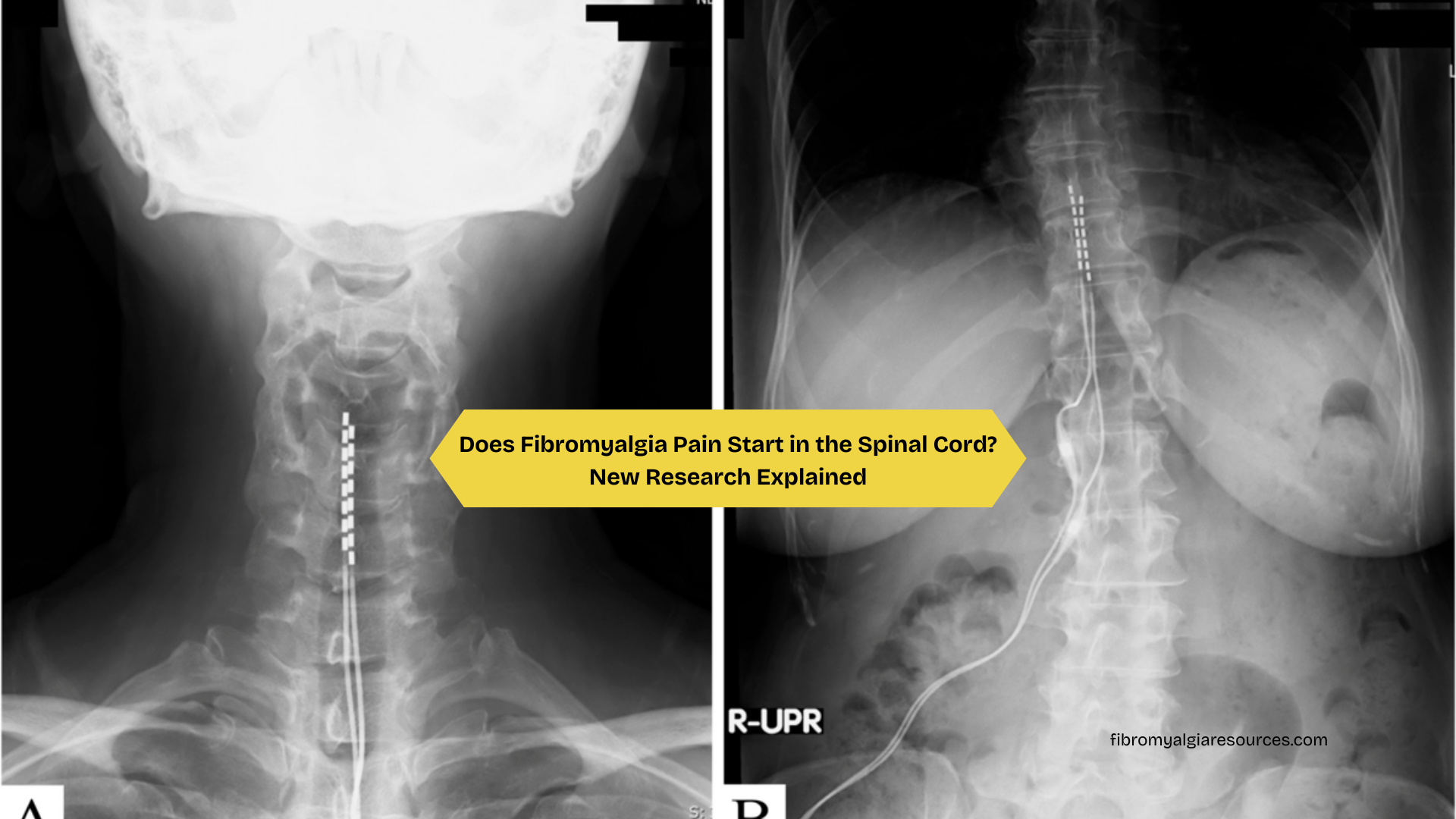
A spinal cord stimulator is a medical device used for certain chronic pain conditions. It delivers electrical stimulation through implanted electrodes near the spinal cord.
The goal is to alter pain signaling.
That naturally raises another question:
Will a spinal cord stimulator help with fibromyalgia?
At this point, it is not considered a standard treatment for fibromyalgia itself.
However, researchers have explored spinal cord stimulation in people with fibromyalgia, particularly when they also have another pain condition that is appropriate for SCS.
An 11-year multicenter retrospective study compared people with and without fibromyalgia who underwent spinal cord stimulation for an approved indication. The researchers found no significant difference in pain relief, satisfaction, or medication use after implantation between the groups.
That is interesting.
But it does not prove that spinal cord stimulation is a treatment for fibromyalgia.
It means people with fibromyalgia who receive SCS for an appropriate indication may still experience outcomes comparable to patients without fibromyalgia.
Spinal Cord Stimulator and Fibromyalgia: What About the Case Reports?
There are also smaller reports.
For example, researchers published two case reports involving women with fibromyalgia who experienced substantial pain relief after high-frequency spinal cord stimulation.
That sounds exciting.
But two cases cannot establish that a treatment works for everyone.
Case reports are useful for generating research questions.
They are not enough to make a treatment standard practice.
That distinction is especially important when a procedure involves implantation.
Why Isn’t Spinal Cord Stimulation a Standard Fibromyalgia Treatment?
Fibromyalgia is widespread.
Spinal cord stimulation is generally designed around specific pain conditions and pain pathways.
If someone’s pain comes from multiple interacting systems, simply stimulating one part of the nervous system may not address everything.
Researchers therefore need stronger evidence.
Future trials would need to answer questions such as:
- Which patients respond?
- Which stimulation frequency works best?
- Does treatment reduce widespread pain?
- How long do benefits last?
- Does it improve sleep or fatigue?
- What are the long-term risks?
- Is it better than less invasive treatments?
Until those answers become clearer, SCS remains a specialized intervention rather than a routine fibromyalgia treatment.
What Is Fibromyalgia Spinal Cord Treatment?
There is no single fibromyalgia spinal cord treatment currently established as a standard therapy.
Instead, treatment usually targets the broader symptom pattern.
That may include:
- Gradual physical activity
- Sleep management
- Psychological therapies
- Pain-management strategies
- Medications
- Education about pacing
- Treatment of coexisting conditions
The idea is to reduce the overall burden on the pain-processing system rather than treating the spinal cord as though it has been physically injured.
Why Understanding the Spinal Cord Could Still Matter
Even if the spinal cord is not the sole source of fibromyalgia, understanding its role could lead to better treatments.
Researchers could potentially identify:
- New pain biomarkers
- Better neuromodulation targets
- More personalized therapies
- Ways to strengthen the body’s natural pain-inhibition systems
- New approaches to chronic pain
The recent research does not provide a final answer.
But it adds another piece to the puzzle.
Fibromyalgia Does Not Mean Your Spine Is Damaged
This is perhaps the most important takeaway.
If you have fibromyalgia, widespread pain does not automatically mean that your spinal cord is injured, compressed, or deteriorating.
Fibromyalgia is associated with altered pain processing.
That can involve the spinal cord, brainstem, and brain.
But fibromyalgia spinal cord pain should not be interpreted as evidence of physical spinal cord damage.
If you develop new neurological symptoms, however, get them checked.
A new symptom deserves a new assessment.
Living With Pain While Research Moves Forward
Research can take years.
Patients cannot wait years to live their lives.
If pain affects your ability to work, it may help to explore ways to adapt your working environment and daily routine. Our guide to jobs for people with chronic pain covers practical considerations for finding work that better fits chronic pain limitations.
The goal is not to wait for one magical breakthrough.
It is to build a treatment plan around what can help now while researchers continue exploring what may help tomorrow.
The Bigger Picture
Fibromyalgia used to be described in much simpler terms.
Today, researchers increasingly view it as a complex disorder of pain processing.
The spinal cord is part of that story.
Studies have detected altered spinal cord activity and differences in how spinal and brainstem networks respond to painful stimulation.
But the newest neuroimaging research suggests that fibromyalgia cannot be reduced to one location. It is a network problem. The body sends signals, spinal cord processes them, brain interprets them.
Pain-modulating systems attempt to turn them down.
In fibromyalgia, that system may behave differently.
Final Thoughts
So, does fibromyalgia spinal cord pain start in the spinal cord?
Not exactly.
The spinal cord appears to play an important role in pain processing and central sensitization, but current research does not show that fibromyalgia begins in the spinal cord or that the spinal cord is physically damaged in the condition. Instead, fibromyalgia appears to involve changes across a wider pain-processing network. That is good news for research.
It means scientists are not limited to looking for one damaged structure. They can study how the entire system communicates.
And as researchers learn more about those signals, the future may bring more precise ways to turn the volume down on chronic pain.
FAQ’s
1. Does fibromyalgia pain start in the spinal cord?
Not exactly. The spinal cord plays a role in processing pain, but fibromyalgia involves a wider network of the nervous system.
2. Can fibromyalgia damage the spinal cord?
Fibromyalgia itself does not typically cause spinal cord damage or compression. Its pain is linked to altered pain processing.
3. What is the connection between fibromyalgia and the spinal cord?
Research suggests that the spinal cord may process and amplify pain signals differently in people with fibromyalgia.
4. Will a spinal cord stimulator help with fibromyalgia?
Spinal cord stimulation is not a standard treatment for fibromyalgia. More research is needed to determine whether it can reliably help widespread fibromyalgia pain.
5. Can fibromyalgia cause spinal cord compression?
Fibromyalgia does not normally cause spinal cord compression. New weakness, numbness, walking problems, or bladder and bowel changes should be medically evaluated.

Disability Invisible illess awareness BUMPER STICKER fibromyalgia – stop ther judging you. Click Here to ge this